Metal Bending: A Guide to Techniques for Steel, Copper and Aluminum
Metal bending is one of the most widespread cold-forming processes in manufacturing, yet the way a material responds to the force of the press brake changes considerably from case to case. Steel, copper, aluminum and stainless steel behave differently in terms of springback, minimum bend radius and even the choice of the machine best suited to work them.
Understanding these differences before the project is even started makes it possible to obtain parts bent to the correct angle, with no cracking, no rework and no surprises at inspection.
Metal Bending for Prototypes and Small-to-Medium Runs
When it comes to bending, the first scenario to consider is prototyping or production in small and medium runs. Here, steel (including pre-galvanized and pre-painted grades), copper and aluminum are among the most requested materials, together with stainless steel.
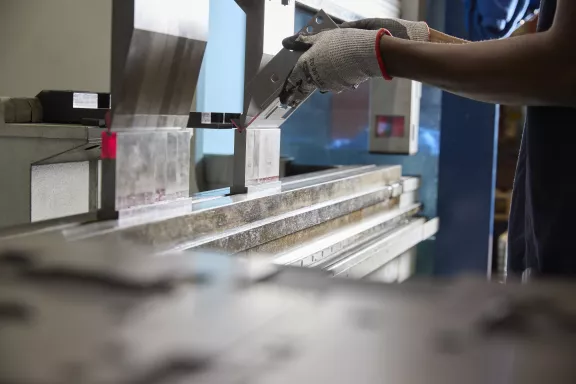
In these contexts, the programmable CNC press brake is the most efficient tool. The sheet is pushed into a V-shaped die by a punch, also called a blade or knife, and depending on how the punch interacts with the die, very different results can be achieved.
Air Bending and Coining: Differences and When to Use Each
In air bending, the punch does not reach the bottom of the die: the bend angle is determined by the programmed stroke of the moving ram, not by full contact with the die.
It is the solution to prefer when:
- Bending force needs to be limited, since the sheet is less worn by friction against the tooling
- Flexibility is required: with a set of punches, several different bend angles can be produced
It should be chosen with care when the required bend angle is very precise or when holes are close to the bend, because in these cases they tend to distort.
If, after bending, the material springs back and the angle opens up, the stroke value must be corrected so as to obtain what the drawing requires, net of the springback.
In coining, by contrast, the punch reaches the bottom of the die and literally squeezes the material against it. This is the technique to adopt when:
- The run grows and dimensional consistency becomes a strict requirement, since it guarantees a more repeatable bend angle across all the parts produced
- The material allows it and tighter radii are needed
It must be pointed out, however, that coining may result in lower quality of the bent edges, which will show more wear, as well as greater tooling wear and a stricter limit on the thickness that can be worked.
Rolla-Type Dies for Precision Bending
Many of the problems inherent in the bending process can be solved with the Rolla-type die, a special die with no groove, fitted instead with two rotating semi-spherical sliders that accompany the sheet through the bend. Its advantages:
- It prevents the sheet from sliding against the edges of the groove, a cause of cosmetic defects
- It allows holes to be made close to the bend without distorting them
- It makes very small bend flanges possible, which is not feasible with standard dies
Hemming: Eliminating Sharp Edges
Hemming is used mostly to eliminate sharp edges on the part, producing a radiused, double-thickness edge in the sheet.
CNC Press Brakes and Panel Benders Compared
Bending is a highly flexible operation: by installing different types of punches and dies on the machine at the same time, multiple shapes can be produced until the part is complete. This is made possible by modern CNC press brakes. The computer automatically controls both the movement of the upper beam that bends the metal and the back gauges that set the flange length. The operator only has to support the part, rest the sheet against the gauges and orient it correctly so that the bend is made on the side required by the drawing.
With the panel bender, even the manual positioning of the sheet against the stops is left to the machine. The sheet rests on a movable table and is held by a clamping blade, while a tool makes the bend side by side, in both directions required by the drawing (upward and downward bends), without the operator having to flip the part. It is a particularly suitable solution for parts with articulated geometries that would be difficult to obtain with a conventional press brake alone.
To explore bending for prototyping and small batches in more depth, read our guide toprototyping in sheet metal fabrication, from design to production.
Bending Thick Sheet Metal
The picture changes considerably when thick sheet metal has to be worked. Here the protagonists are usually steel and ferrous materials, including pre-galvanized ones, especially in sectors such as marine, energy and construction, where medium-to-heavy structural fabrication components are used.
In these cases, sheet thickness is not the only parameter to consider. Account must also be taken of:
- Length of the part
- Desired bend angle
- Mechanical properties of the material
- Maximum force available on the press brake
Bends on thick material are generally made by air bending, to limit bending force. Only by putting all these variables together can the required tonnage, that is, the bending force needed, be calculated precisely, together with the inside bend radius, the die opening and the minimum flange needed for a flawless result.
The machines involved are high-tonnage press brakes, often equipped with sheet followers that position the sheet correctly before straight, parallel bends are made. In the most demanding cases, genuine robotic bending cells are used, designed specifically to handle the heaviest thicknesses with the repeatability that industrial production requires.
This is also covered in our guide tothe secrets of bending thick sheet metal.
Bending Copper: Techniques and Precautions
Copper deserves a separate discussion because, unlike steel and aluminum, its main challenge is not so much the force needed to bend it as the care required in handling its surface.
It is a metal valued for its electrical and thermal conductivity and its excellent malleability, which makes it relatively easy to bend even into complex geometries and precise angles, limiting the risk of breakage or cracking that might be feared with harder materials.
This electrical and thermal conductivity makes copper widely used in sectors such as electronics and electromechanics, but it must be stressed that copper is particularly sensitive to scratches and surface imperfections. Those who work with it must therefore adopt specific measures, such as:
- Protective films on the sheets
- Dies with an increased radius
- Rotating tools, using the technique known as Rolla-type bending
These measures serve to preserve the aesthetic quality of the finished part along with its dimensional accuracy.
Here too, control of the bend radius, the applied force and the springback remains essential, the latter being in any case lower than in other metals thanks to the natural malleability of copper.
Ourguide to copper bending helps to understand the whole process.
Bending Aluminum: Managing Springback
Aluminum, finally, combines lightness and malleability in a way that makes it one of the easiest metals to bend to the customer's specifications. It is precisely this workability that makes it a widely used alloy in sectors where the strength-to-weight ratio plays a central role in component design.
The main difficulty in bending aluminum, however, lies in controlling springback which, at equal thickness, is generally more pronounced than in ferrous materials, although less so than in stainless steel. Bending aluminum requires adequate springback compensation and careful control in production.
The specific aluminum alloy chosen for the project also affects behavior during bending, which is why each case must be assessed individually with the customer before production starts. There are in fact several types of wrought aluminum alloys, and each may come in a different heat-treatment and strain-hardening condition, which significantly changes the mechanical characteristics of the aluminum, improving or worsening its suitability for bending.
The minimum bend radius also depends on the hardness and strain hardening of the material:
- With softer materials, small radii can be obtained
- With harder materials, the radius must be larger, to avoid cracking on the outside of the bend
How to Choose the Right Bending Process
Putting together everything said so far, it is clear that choosing the correct bending process always depends on a combination of factors: the specific material, its thickness, the angle required by the drawing, the presence of holes or openings near the bend and the expected production volumes.
- Prototypes and small-to-medium runs: the programmable CNC press brake remains the most accurate and cost-effective solution, starting even from single-piece lots
- Parts with complex bends on multiple sides: the panel bender guarantees repeatability even on articulated geometries
- Greater thicknesses, whatever the metal: press brakes sized for the required tonnage become decisive or, in the most demanding cases, dedicated robotic cells
In every scenario, the starting point remains the same: an in-depth technical discussion with the customer to understand the end application of the part and, on that basis, identify the machine, the type of bend and the parameters best suited to obtaining a correct result from the very first part produced.
Metal Bending at Minifaber
Since 1960, Minifaber has supported companies in very different sectors, from electromechanical to medical, from gas distribution to vending and energy distribution, up to professional lighting, with a machine fleet made up of 7 CNC press brakes and one panel bender.
Every job, whether in steel, copper, aluminum, stainless steel or special alloys, starts with an analysis shared with the customer to identify the most effective strategy, assessing right away the most suitable machine, the type of bend to adopt and the technical parameters needed to achieve the required result.
Anyone with a project to evaluate can contact Minifaber for a technical discussion and a no-obligation quote.