Sheet Metal Die Design: Steps, Materials, Maintenance
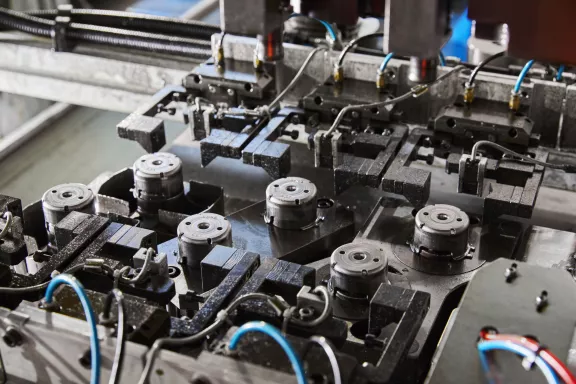
Sheet metal die design is one of the most strategic phases in the cold metal stamping process. It is not simply about building a tool, but about defining the technical architecture that will ensure quality, repeatability, long-term durability, and the economic sustainability of the manufacturing process.
At Minifaber, the design and manufacturing of sheet metal dies - whether progressive, transfer, or for deep drawing - is carried out in-house, ensuring full control over performance, durability, and process optimization.
What Is Meant by Sheet Metal Dies
Sheet metal dies are mechanical tools designed to deform, cut, or form sheet metal through the combined action of punches and dies, as well as spring-loaded elements such as blank holders and ejectors. These elements are assembled together with other parts into the die structure, which is in turn mounted on mechanical presses, servo presses, or hydraulic presses.
This makes it possible to perform operations such as:
- blanking
- bending
- deep drawing
- coining
- sizing
- threading
In the case of cold stamping, the process takes place at room temperature through controlled plastic deformation of the material, ensuring dimensional accuracy and surface quality.
The effectiveness of the process depends first and foremost on accurate design, carried out by an experienced team and tailored to the characteristics of the part, the material, and production volumes. When necessary, before the design phase begins, a feasibility study is carried out using scientific finite element analysis software such as Autoform and Deform, which make it possible to simulate the stamping process.
Sheet Metal Die Design: The Strategic Phases
The design of a sheet metal die is divided into integrated technical phases.
The first phase is the technical analysis of the component, during which geometry and tolerances, material and thickness, functional requirements, potential critical issues, and production volumes are assessed.
This first step makes it possible to identify - after careful analysis - the most suitable technology: progressive, transfer, or deep drawing.
From here comes the choice of die type. To make this decision, it is useful to understand the differences between them.
Progressive Dies: Efficiency for Serial Production
Progressive dies are designed to process a continuous strip of sheet metal fed by a die feeding line where the material coil is loaded.
The operation of these dies is distinctive: each press stroke corresponds to an advancement of the strip, called the Pitch, and specific operations are performed at each station. The part is then separated from the strip only at the final station.
The progressive die is the ideal solution for small- or medium-sized components, when production volumes are medium to high, when tight tolerances are required, and when maximum productivity is needed.
The advantages of the progressive die are numerous:
- high production speed
- reduced unit cost on large volumes
- consistent and repeatable quality
- highly automatable process
Transfer Dies: Control for Medium-to-Large and Complex Parts
Transfer dies differ significantly from progressive dies. In this case, the part is blanked from the strip immediately at the first station, processed individually, and transferred from one station to the next by a mechanical or robotic system. Each station performs a distinct phase of the process, working on the individual part rather than on a continuous strip as in the progressive die.
This type of die is recommended when the part is medium-to-large and deep, when the active parts of the die are bulky, or when the operations require more space between stations.
Here too, the advantages are numerous:
- greater flexibility in operations
- better handling of complex and deep geometries
- lower risk of interference between operations
At Minifaber, transfer dies operate on both mechanical presses and dedicated servo presses, the latter with adjustable force, speed, and stroke parameters during servo motor rotation.
Deep Drawing Dies: Controlled Three-Dimensional Deformation
Deep drawing dies are designed to transform a flat sheet into a hollow three-dimensional shape, such as cookware and sinks.
They make it possible to produce cups, cylinders, containers, and deep components without welding. They are therefore required when the component is hollow, has significant depth relative to its diameter, or requires structural continuity.
The advantages of sheet metal parts made with deep drawing dies are:
- no joints
- high mechanical strength
- better overall cost-effectiveness compared with assembled or welded parts
Materials Used for Die Manufacturing
The quality of a die depends on the choice of materials used for its construction.
The following are used:
- high-alloy carbon steels
- remelted steels
- powder metallurgy steels
- tungsten carbide
These are combined with:
- heat treatments
- precision polishing
- PVD coatings
PVD coatings improve surface hardness, wear resistance, and anti-adhesive properties, reducing friction and galling.
Sheet Metal Die Maintenance: Continuity and Durability
Die maintenance is essential to ensure long-term stability. It can be either preventive or extraordinary.
Preventive maintenance for sheet metal dies is carried out to keep the die consistently efficient, avoiding breakages and production downtime, and ensuring ongoing part accuracy and compliance. It includes:
- inspection of wear on punches and dies, and more generally on all parts subject to wear and high stress
- inspection of elastic elements
- verification of the alignment of die components that mate during stamping
- inspection of guides and bushings
- cleaning and lubrication
- anything else required
Extraordinary maintenance, on the other hand, is carried out when the die has reached the end of its warranty life, meaning the number of cycles beyond which continuing production becomes risky. It includes:
- complete disassembly of the die to analyze every component
- replacement of active parts
- replacement of worn parts
- replacement of guides and bushings
- reapplication of PVD coatings
A structured maintenance approach reduces scrap, downtime, and indirect costs.
Materials That Can Be Processed with Sheet Metal Dies
Dies designed for cold stamping can process:
- ferrous and low-alloy materials
- stainless steels
- pre-galvanized materials
- pre-painted materials
- aluminum and light alloys
- copper, brass, cupronickel
Proper evaluation of the material’s mechanical properties is already crucial during the design phase.
When It Makes Sense to Invest in a Dedicated Die
Sheet metal die design is a strategic choice when:
- production volumes are medium to high
- repeatability is a fundamental requirement
- unit cost must decrease over the medium term
- multiple operations need to be integrated into a single cycle
At Minifaber, both design and manufacturing are handled in-house, quality control is continuous, and maintenance is structured. In this way, the die can be transformed from a simple tool into an optimized production system.
Do You Have a Project to Develop?
If you are considering the production of progressive dies, transfer dies, or deep drawing dies, the Minifaber technical team can support you in choosing the most efficient technology and designing the most stable process.