Metal Deep Drawing: how it works and when it is useful
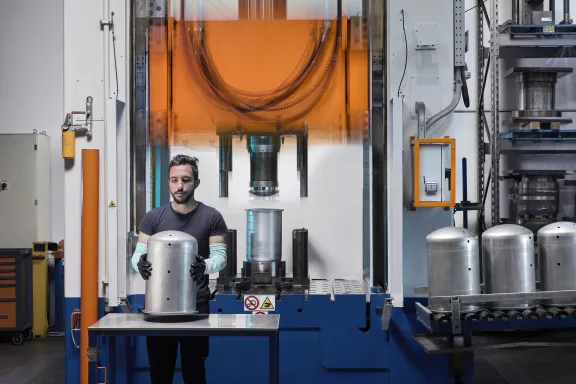
Metal deep drawing is one of the main cold forming technologies for producing three-dimensional hollow components from flat sheets of various sizes. The sheet metal is plastically deformed inside a die by the pressure applied by a press, without heating the material. This technology makes it possible to produce complex, strong shapes without the need for welding.
Minifaber does not limit its expertise to deep drawing of ferrous sheet metal, but also works with stainless steel, aluminum, copper, brass, and special alloys. Each process is adapted to the specific characteristics of the material being formed, ensuring consistently high-quality results.
This is possible thanks to the careful design of each stage of the process, which guarantees reliability, repeatability, and industrial-level performance, even for complex geometries and large-volume production.
What is deep drawing and how the process works
Deep drawing is a plastic deformation process without material removal, in which the metal sheet called a blank is pushed into the cavity created in the mold between the die and the punch. Control of the material flow is almost always entrusted to the sheet presser, whose appropriately adjusted force prevents defects such as tears, wrinkles, or uncontrolled thinning.
The deep drawing process consists of several stages. The first one involves material selection, which must be aligned with the customer’s design requirements and the manufacturing process—namely deep drawing—while taking into account material properties such as strength, formability, and surface finish.
The next step is die design and definition of the forming sequence. This is a critical phase in deep drawing, as it determines the necessary processing steps. Depending on the part geometry, one or more drawing operations may be required to achieve the desired shape.
Any subsequent trimming, calibration, or complementary stamping operations must then be evaluated.
Deep drawing of different materials: expertise and advantages
Working with different materials means adapting the deep drawing process to significantly different mechanical behaviors. This involves adjustments in die design, press parameters, forming sequences, and process controls, including lubrication and the geometry of the initial blank.
The ability to manage this level of adaptation is a key indicator of the industrial value of a specialized partner such as Minifaber.
Stainless steel deep drawing
The deep drawing of stainless steel requires specific designs and processes depending on the type of stainless steel to be used. There is a wide variety of stainless steel alloys, which generally have high mechanical strength in common compared to other materials.
Stainless steel is chosen for manufacturing components because of the corrosion resistance properties offered by these alloys. Examples include the household appliance, food equipment, and medical sectors, as well as technical applications such as boiler manufacturing. In these cases, the correct design of the deep drawing cycle allows uniform surfaces and constant tolerances to be obtained within certain limits, reducing the risk of breakage, wrinkles, and excessive work hardening of the material. For these materials, careful control must also be exercised over the elastic recovery of the part after deep drawing.
Aluminum deep drawing
Aluminum deep drawing is particularly suitable for applications where weight reduction is a key factor. For certain aluminum alloys, the material’s high malleability allows complex geometries to be produced with reduced thicknesses, while maintaining an excellent strength-to-weight ratio.
This type of processing requires specific expertise, especially when the component has aesthetic requirements. In such cases, special attention must be paid to surface protection. Aluminum deep drawing is widely used in the electromechanical sector, professional lighting, and industrial applications in general.
Deep drawing of steel and coated materials
Deep drawing of steel, including galvanized or coated variants, is a highly efficient solution for high-volume industrial production. In this context, optimization of the stamping cycle is crucial to ensure productivity, repeatability, and cost control.
In-depth knowledge of coatings and their behavior during deformation makes it possible to preserve the protective properties of the material, preventing damage or functional alterations.
Copper and brass deep drawing
Deep drawing of copper and its alloys, such as brass and cupronickel, is used to manufacture technical components where properties like electrical and thermal conductivity are required. For this reason, these materials are widely used in the electromechanical industry.
Although these materials are ductile and highly formable, they require advanced technical expertise and experience, both in die design and in process engineering. This includes the correct selection of lubricants, which must not alter the surfaces or trigger corrosion phenomena.